How to remove leaked OnlyFans content: a step-by-step guide
A guide for OnlyFans creators on removing leaked content. It covers what leaks actually cost you and how the theft works, then walks through DMCA takedowns and monitoring so copies don't come back.
 How to remove leaked OnlyFans content
If your OnlyFans content has leaked, here's how to remove it: document every instance, file platform-specific takedowns in order of how fast content spreads, then set up ongoing monitoring so new copies don't resurface. This guide walks through that sequence step by step.
Discovering a leak is one of the most disorienting situations a creator can face. It triggers financial loss, reputation damage, and a real sense of violation. But you are not powerless, and piracy should not be treated as a normal work hazard.
How content leaks damage your business
Revenue impact
Free pirated copies devalue your subscription directly. A potential subscriber who finds your content on a leak forum has no incentive to pay. For PPV-focused creators, the damage is sharper: a single “group buy” - where 10-20 people pool $5-10 each to fund one subscription, then share all downloads - can expose an entire PPV catalogue to hundreds of people who never paid for it.
Monthly recurring revenue drops when subscribers decide exclusivity is gone. A single high-value fan (“whale”) who finds your PPV content for free represents a loss that can exceed hundreds of dollars per incident.
How an active leak erodes creator MRR:
| Stage | Change | MRR after |
|---|---|---|
| Baseline, no leaks | none | $3,000/mo |
| PPV group-buy theft | -20% | $2,400/mo |
| Subscription non-renewals | additional -20% | $1,800/mo |
| Brand damage and churn | additional -15% | $1,350/mo (actual MRR under an active leak) |
Brand and trust impact
Leaked content typically surfaces on low-quality piracy sites with spam ads and misleading thumbnails. When a new potential subscriber first encounters your content in that context, the professional image you have built is undermined before they even visit your actual profile.
Existing subscribers who notice their “exclusive” content is freely available may not renew. Trust, once damaged, is expensive to rebuild.
Why agencies cannot afford to be passive
Agencies managing multiple creators face a compound risk: a single unaddressed leak can set a precedent that attracts more scraping. Agencies must treat monitoring as infrastructure - not a reactive service triggered only when a creator reports something.
Platforms like X, Reddit, and Telegram are typically where leaks first appear before migrating to file-sharing sites and torrent directories. Intercepting a leak at the social media stage costs far less effort than chasing it across 20 downstream mirrors.
How OnlyFans content gets stolen
Understanding attack vectors helps you close gaps before they are exploited.
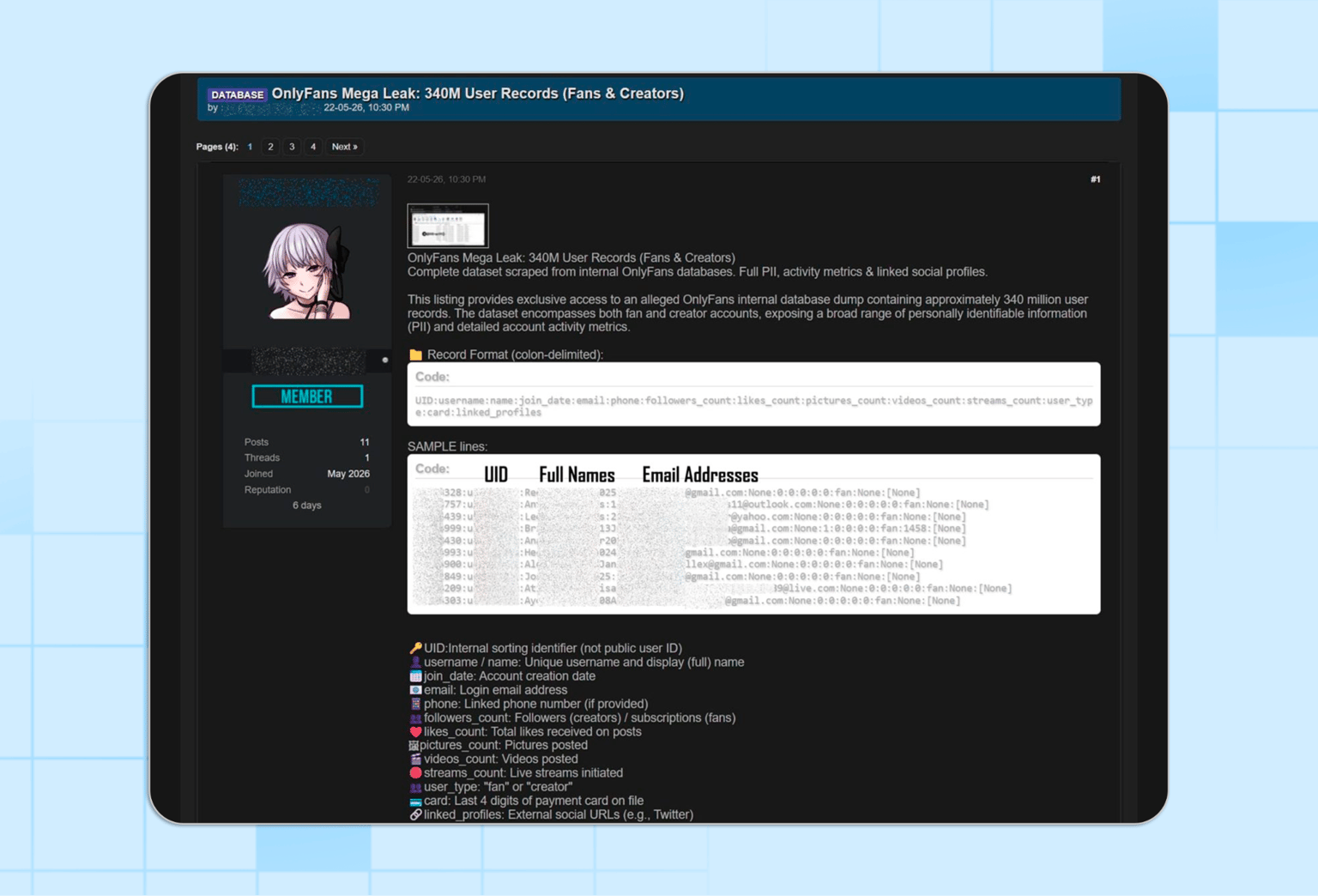 Screenshot of a forum distributing stolen OnlyFans content
- Screen recording: DRM is designed to block recording software, but determined actors bypass it using hardware capture cards or specialized software that intercepts the video stream before encryption is applied.
- Browser extensions and scraping bots: Automated bots can download every media file from a profile within minutes. A single bot run can archive months of content.
- Group buys: A shared subscription funded by 10-20 people, then distributed privately. Files often spread further than the original group intended.
- Insider leaks: In rare cases, a trusted subscriber - sometimes even a collaborator - is the source. Forensic watermarking (covered in the Prevention section) can identify the source.
Immediate response: what to do in the first 24 hours
Speed matters. The faster you act, the fewer copies proliferate.
Step 1: Document everything before you request removal
Do not close the browser tab. Open a spreadsheet and log every instance you find:
- Full URL of the infringing page
- Date and time of discovery
- Screenshot of the page with URL visible in the browser bar
- Platform or site name
- Username of the uploader, if visible
- Whether the content is hosted directly or linked from elsewhere
This evidence log is the foundation of every takedown request you will file. A DMCA notice without a specific URL and proof of ownership can be rejected.
Step 2: Triage by platform priority
Not all platforms spread content at the same speed. Address them in order of how fast they distribute content outward - social media first, then search engines, then video hosting, then file-sharing lockers, then forums.
| Priority | Platform | Spread speed | Act within |
|---|---|---|---|
| Critical | X, Reddit, Telegram | Hours | < 2 hours |
| Critical | Google / other search | Days | < 24 hours |
| High | Video hosting sites | Days | < 48 hours |
| Medium | File-sharing lockers | Weeks | < 7 days |
| Lower | Forum boards | Weeks-permanent | < 30 days |
Step 3: Escalate to legal partners when standard channels fail
Standard reporting works for most cases. Escalate to legal counsel when:
- A takedown request is ignored for more than 7-14 days
- The same account repeatedly re-uploads after removal
- Personal information has been exposed alongside the content - this moves into personal safety territory
- The hosting provider is unresponsive, with no visible abuse contact
Legal partners can issue cease-and-desist letters on law firm letterhead, which carry significantly more weight than creator-submitted notices. Hosting providers that ignore informal requests typically comply when formal legal correspondence arrives - or face potential lawsuits.
If you work with an agency that has legal contacts on retainer, this is the moment to call them: explain the situation and ask them to help escalate reports and file takedown notices.
Filing DMCA takedown notices correctly
The Digital Millennium Copyright Act (DMCA) could be very useful here. Although it's a US law, the DMCA is generally recognized across much of today's internet. Submitting a takedown request under the act is a legal procedure and must be carried out accordingly.
What a valid DMCA notice must include
A notice missing any of these elements gives the recipient grounds to reject it:
 Legal removals
- A physical or electronic signature of the copyright owner or a person authorized to act on their behalf
- Identification of the copyrighted work claimed to have been infringed (e.g., a link to your official profile or the original post)
- The exact URL(s) of the infringing material - one notice can list multiple URLs on the same site
- Your contact information: name, address, and email
- A good-faith statement that the use of the material is not authorized by the copyright owner, its agent, or the law
- A statement, made under penalty of perjury, that the information in the notice is accurate and that you are the copyright owner or authorized to act on the owner's behalf
Where to submit
Google Search: Google's Legal Help center has a dedicated dashboard for copyright removal requests. Removing infringing pages from search results cuts the pirate site's traffic.
Cloudflare: Many piracy sites use Cloudflare to hide their real hosting provider. If you cannot identify the host, send your DMCA notice to Cloudflare's abuse form and it will forward the infringement notice to the site's actual web host.
Social platforms: always use the platform's dedicated copyright infringement form rather than a general “harassment” or “abuse” report. Copyright reports route to a dedicated legal team instead of general moderators and are processed significantly faster.
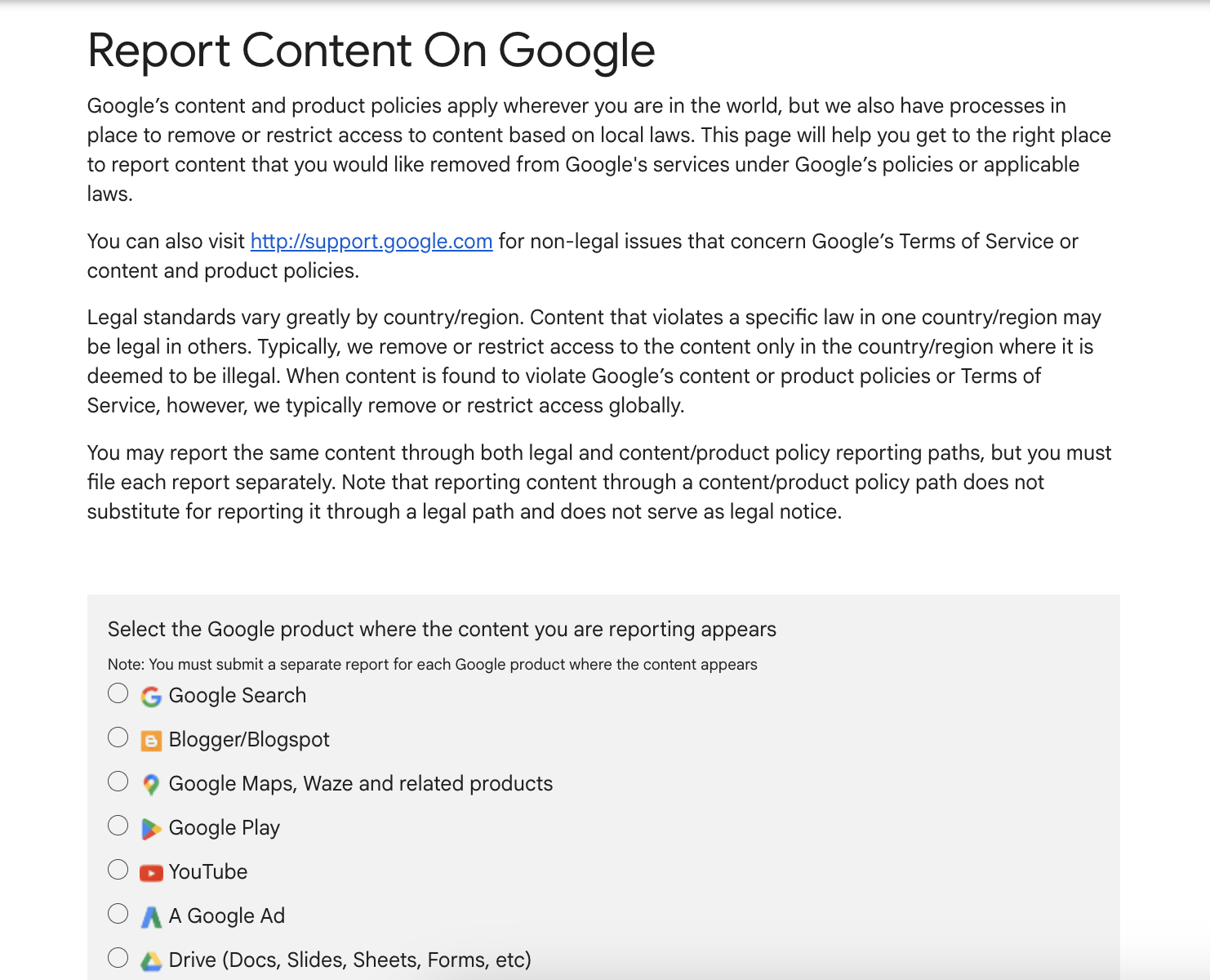 Report content on Google
Why agencies outperform solo creators at scale
A single DMCA notice takes 10-30 minutes to prepare correctly. When a creator has 50-200 infringing URLs to address, that workload is unsustainable alongside content creation.
Agencies using enterprise takedown software scan the web continuously and batch-file notices at volumes impossible for a single creator. Some agencies hold “Trusted Flagger” status on major platforms, meaning their notices are reviewed first - a meaningful advantage when a viral leak is spreading by the hour.
A piracy site that ignores an individual creator’s notice will pay closer attention when an agency representing 300 creators threatens litigation.
Monitoring tools and professional removal services
Even if you're an OnlyFans creator with content that's been stolen and shared online, there's only so much you can do on your own. You have to sleep at some point, and so does any human takedown service provider you hire. Automated content monitoring tools fill that gap by constantly scanning the web for your content. DMCA monitoring services such as Rulta and BranditScan crawl the web on a schedule, scanning piracy sites, torrent directories, Google Images, and social platforms for copies of your content. When a match is found, they alert you and, depending on the plan, can auto-submit takedown notices.
| Feature | DIY solo | Agency |
|---|---|---|
| Volume capacity | 1-10 notices/day | 100s/day, automated |
| Modified copy detection | Manual review only | AI plus human hybrid |
| Legal leverage | Creator letterhead | Law firm letterhead |
| Platform queue | Regular queue | Trusted Flagger status |
| Speed per notice | 15-30 min each | Minutes, automated |
| Best for | Under 20 leaks/month | Ongoing monitoring |
Their limitation: if a pirate re-encodes a video, crops it, or changes the filename, automated matching may miss it. A hybrid approach - software plus human review - catches significantly more.
When to hire a professional removal service
Consider a paid removal service if:
- DIY takedown requests have been rejected or ignored
- Pirated content ranks above your official profile in search results
- You manage a content catalogue larger than 100 pieces
- A major leak is actively driving down monthly subscription renewals
Preventing future leaks
Reaction is expensive. Prevention is cheaper.
| Account security | Content protection | Subscriber hygiene |
|---|---|---|
| 2FA on OnlyFans account | Visible watermark on all videos | Review the subscriber list monthly |
| 2FA on email account | Visible watermark on all photos | Bait content deployed (agency) |
| Unique password (password manager) | EXIF metadata stripped before upload | Geo-blocking enabled |
| No shared login credentials | Forensic watermarking (advanced) | Remove suspicious accounts |
Technical measures
- Watermarking: Embed a visible or invisible watermark in every piece of content. For the video, place it in a corner that is difficult to crop out. For invisible forensic watermarking, specialized services embed unique identifiers per viewer - if that file leaks, the identifier reveals which subscriber account it came from.
- Geo-blocking: If your platform supports it, restrict access to regions with high piracy traffic and no paying subscriber base.
- Metadata hygiene: Smartphones embed GPS coordinates in photos by default. Strip EXIF metadata before uploading any image.
- 2FA: Enable two-factor authentication on OnlyFans, your email account, and all linked social accounts.
Agency-level protective workflows
Agencies add a layer that creators cannot easily replicate on their own. Subscriber vetting flags suspicious behavior instead of accepting every credit card: if a new fan subscribes and immediately mass-likes hundreds of posts within an hour, that is a signature of a scraper bot.
Agencies also deploy bait content - files planted with unique, invisible tracking codes. If such a file surfaces on a piracy site, the code identifies exactly which subscriber account downloaded it. The agency can then ban that account and threaten legal action. This forensic approach deters leaks because thieves know they can be caught.
Creator education
Many leaks trace back to security gaps the creator was unaware of:
- Unique password for every platform, stored in a password manager
- 2FA enabled on all accounts
- EXIF metadata stripped from all photos before upload
- Login credentials never shared - use platform-level access controls for any assistants
- The subscriber list is reviewed periodically for suspicious activity patterns
Conclusion
Content leaks are a genuine threat to creator revenue and reputation, but they are manageable with a structured response: document first, triage by platform speed, file DMCA notices correctly, and keep monitoring after the initial cleanup.
No single measure eliminates risk. Fast response, ongoing monitoring, and hardened account security together make piracy costly enough that most of it stops paying off.